
He Just Wanted to Go Home
Joc-O-Sot, Walking Bear, fought in the Black Hawk War, met Queen Victoria, and died in Cleveland in 1844 trying to get back to Iowa. He never made it.
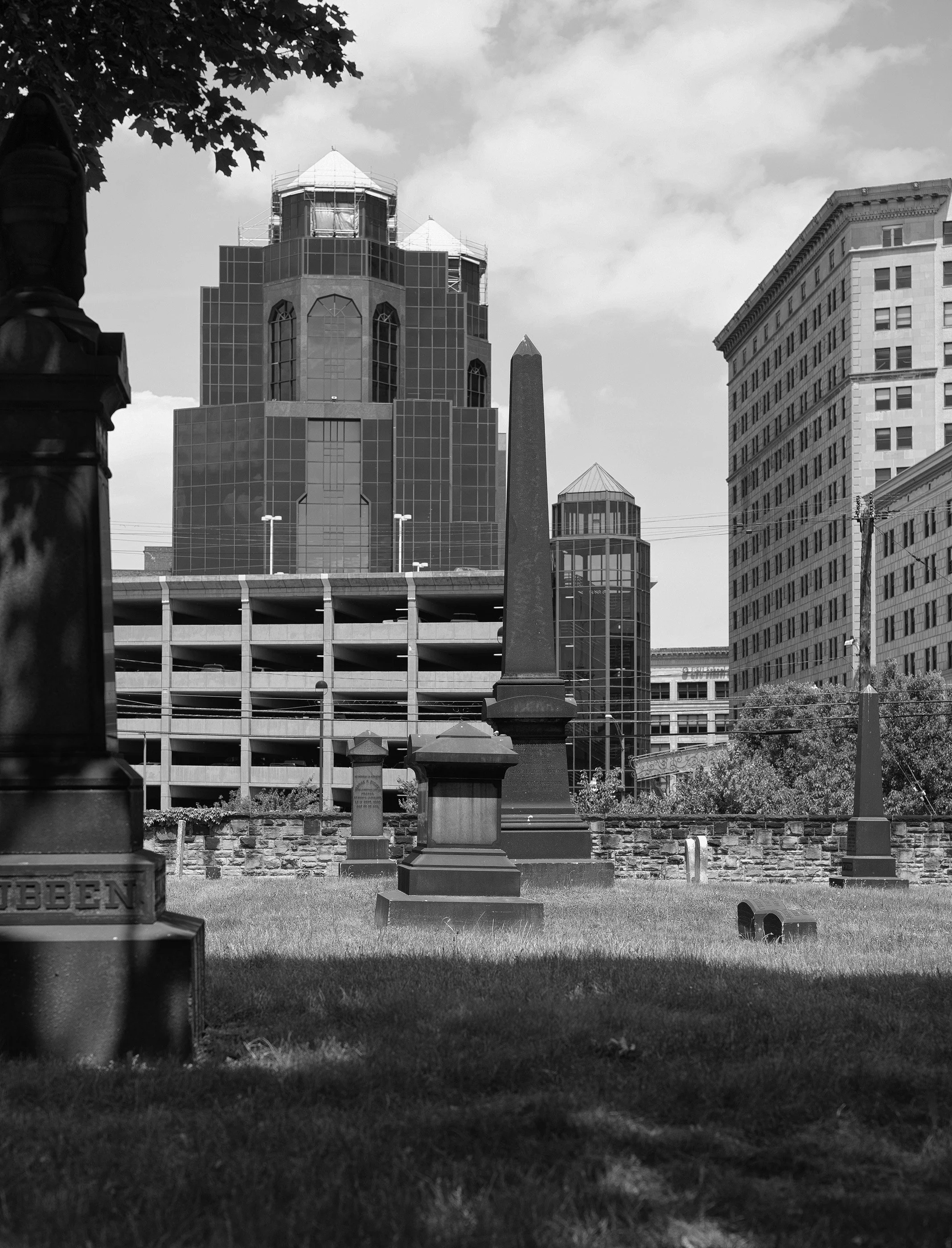
Erie Street Cemetery, East 9th Street, Cleveland. The city has grown up on all sides. The dead hold their ground.
A groundskeeper pointed me toward the stone. He said you need to see the Indian chief. I didn't know what I was walking toward.
Erie Street Cemetery sits in the heart of downtown Cleveland, hemmed in on all sides by the city that grew up around it. Established in 1826, it holds nearly 8,000 burials — Cleveland's founders, its first mayor, Civil War veterans, immigrant families, and the forgotten poor. Progressive Field is directly across the street. On a game day you can hear the crowd from the graves.
It is one of the most compressed, unsentimental burial grounds I have ever photographed. No pastoral buffer, no softening canopy. Just stone and city, separated by an iron fence.
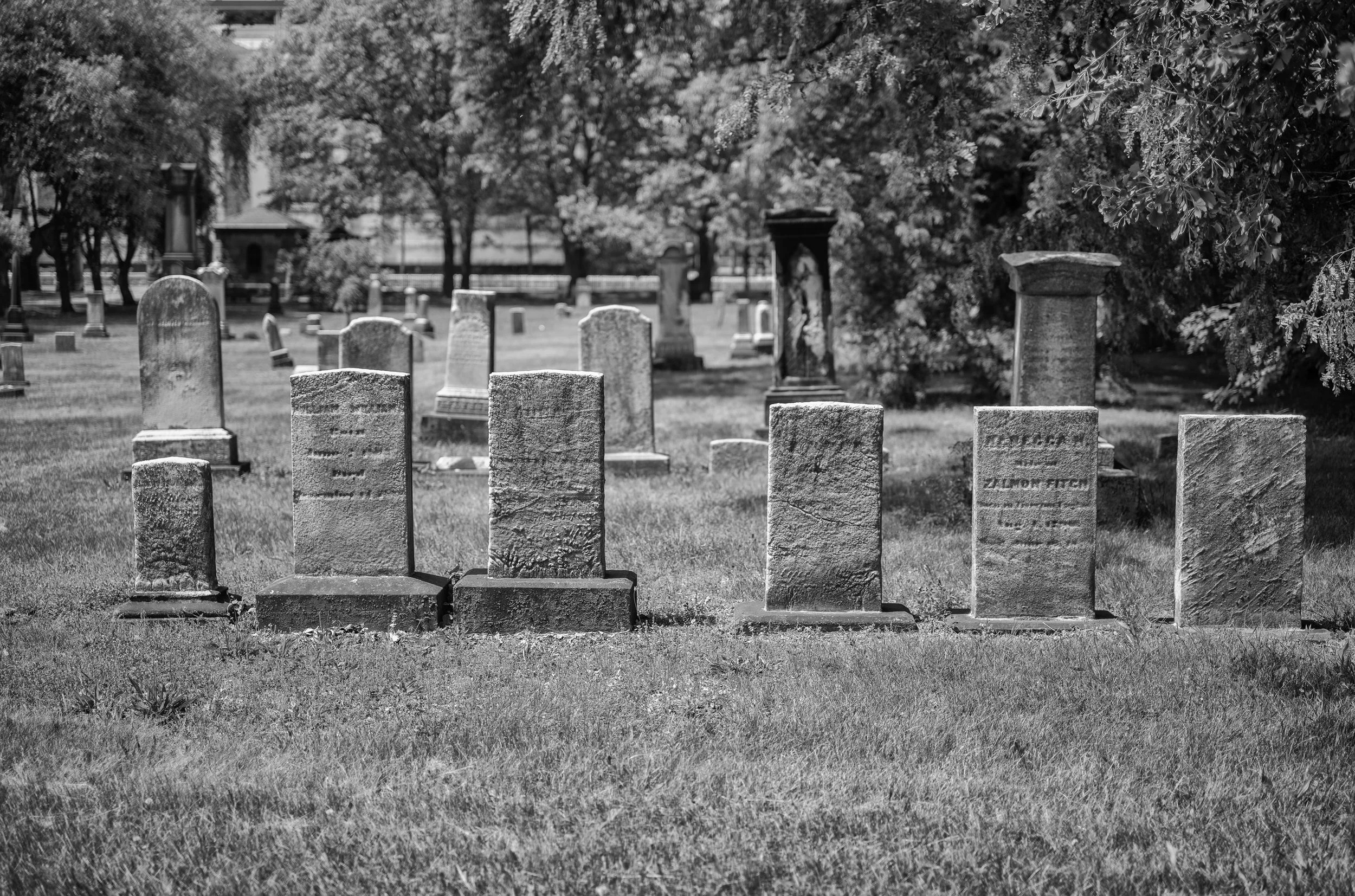
The open character of Erie Street. No tree canopy to soften the light. The city presses in from every side.
The groundskeeper was right. I needed to see the stone.
The Black Hawk War, 1832
Joc-O-Sot — Walking Bear — was born around 1810 in Saukenuk, Iowa, the ancestral home of the Meskwaki people. His father, Katuchasha, had earned the name "The Bear" through his exploits in war against the Osage Nation. The name carried forward.
In 1832, the Meskwaki allied with the Sauk under the leader Black Hawk in a desperate attempt to reclaim their homeland in Illinois, which the United States had taken by treaty. Joc-O-Sot personally tried to prevent the war, but fought in it as a Meskwaki leader when it came, suffering serious wounds in the conflict. Black Hawk's forces were defeated. The land was lost. The people were pushed further west.
Joc-O-Sot carried a wound from that war for the rest of his life. It would eventually kill him.
He tried to prevent the war. He fought in it anyway. He carried the wound west to Cleveland and then east to England and then back again, and it followed him all the way to the end.
Cleveland, and the Stage
Following the defeat of Black Hawk, Joc-O-Sot made his way east to Cleveland in the early 1830s, where he began leading hunting and fishing expeditions and became a close companion of Dr. Horace Ackley. Through Ackley's circle he came to the attention of theater promoter Dan Marble.
What followed was one of the stranger trajectories of 19th century American life. He joined Marble's theatrical troupe, touring cities across the Eastern United States performing in plays which purported to represent Native American life — a warrior chief turned performer, teaching audiences about a world they had spent decades trying to destroy. He also served as Indian Ambassador to President Tyler, carrying the concerns of his people to Washington.
In March 1844, at the behest of Marble, Joc-O-Sot traveled to England in the company of Irish composer William Vincent Wallace. In June 1844, Joc-O-Sot was received in audience by Queen Victoria. She was so impressed she commissioned a royal portrait of him. A Meskwaki chief from Iowa, born the year Madison was president, sitting for a portrait commissioned by the Queen of England.
He met Queen Victoria in June. He was dead by September. He was 34 years old.
The Return
He fell ill in England — likely tuberculosis, likely complicated by the old Black Hawk War wound that had never fully healed. He made his way back to Cleveland on his own, sick and trying to get home to Iowa. Among his last words, recorded by those who attended him: "Joc-O-Sot go up."
He died September 3, 1844, in Cleveland. He never made it home.
His stone was erected by ten citizens of Cleveland and a friend from Cincinnati. Not his people. Not his nation. Ten Clevelanders who had known him, or known of him, and felt the obligation. The original stone was damaged by vandals in 1907. A new bronze and granite monument was placed in 1940 by the Western Reserve Early Settlers Association. Both stones are still there.
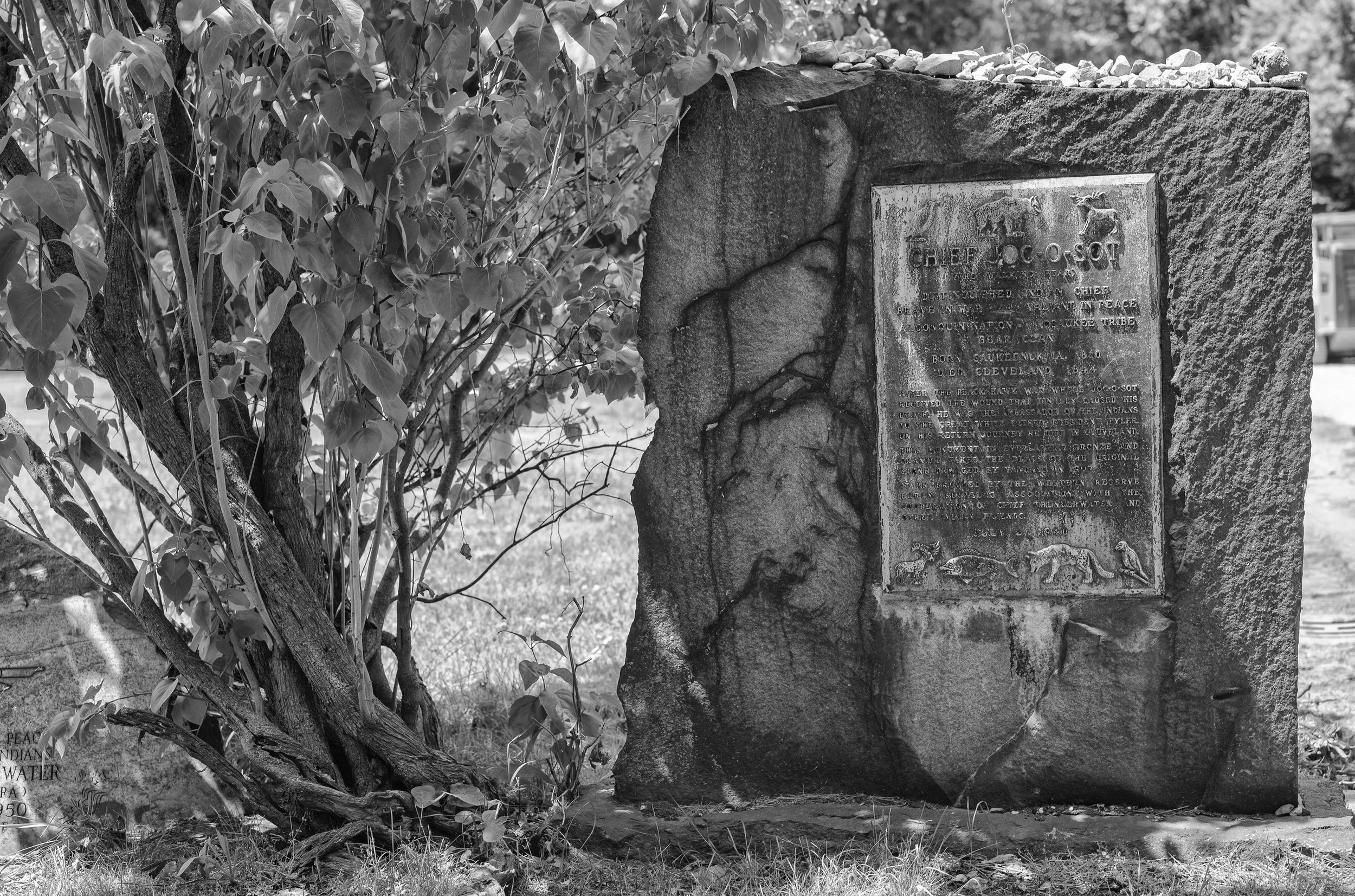
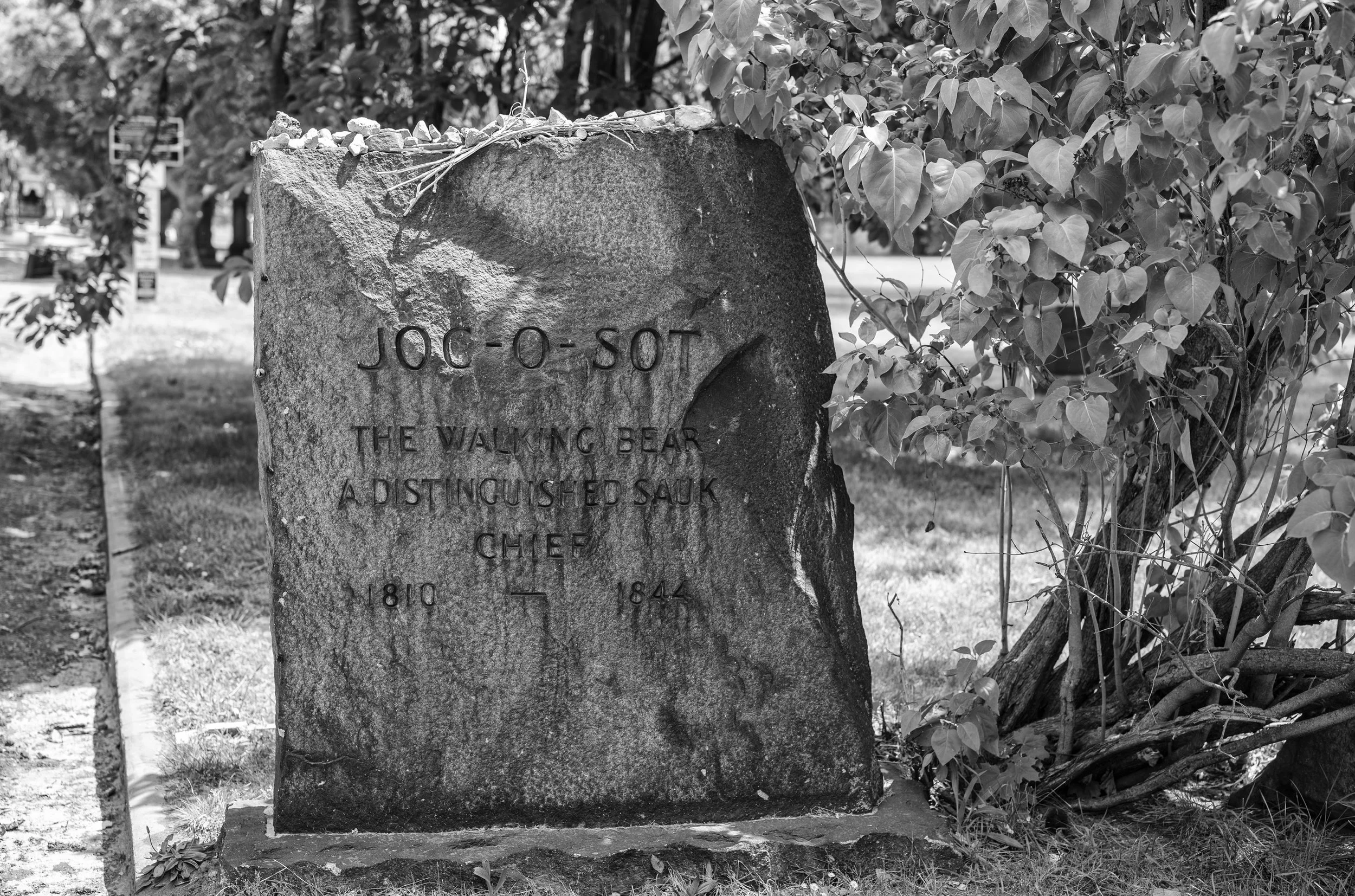
Left: the 1940 bronze and granite monument, stones placed along the top in the Native American tradition of remembrance. Right: the original stone, cracked through, still standing beside it. Both say the same thing. Both mean different things.
The Stones on Top
Look at the top of the 1940 monument. Someone has placed small rocks along the entire edge — a line of them, carefully arranged. This is a Native American tradition of remembrance, the equivalent of leaving flowers. It means someone who knew the custom was here. It means people still come.
The original cracked stone stands beside it. The crack runs diagonally through the face, splitting it almost in two. Whether it was vandals in 1907 or, as local legend insists, the angry spirit of a chief who never wanted to be buried in Cleveland — the stone is cracked and it is still standing and it still says his name.
JOC-O-SOT. The Walking Bear. A Distinguished Sauk Chief. 1810 — 1844. That's all it says. The rest you have to go find.
There is one more thing the historical record notes, quietly, in a subordinate clause. It is probable that Joc-O-Sot's remains were taken from his grave and used for medical experimentation, a practice that was all too common during the 1840s. The grave that people visit, leave stones on, photograph, and tell stories about — may have been empty for nearly 180 years.
He never made it home. And then, possibly, even that was taken from him.
The stones on top of the monument mean someone knows. Someone still comes anyway.
I'm glad the groundskeeper pointed me toward it.
