
Honor Flight
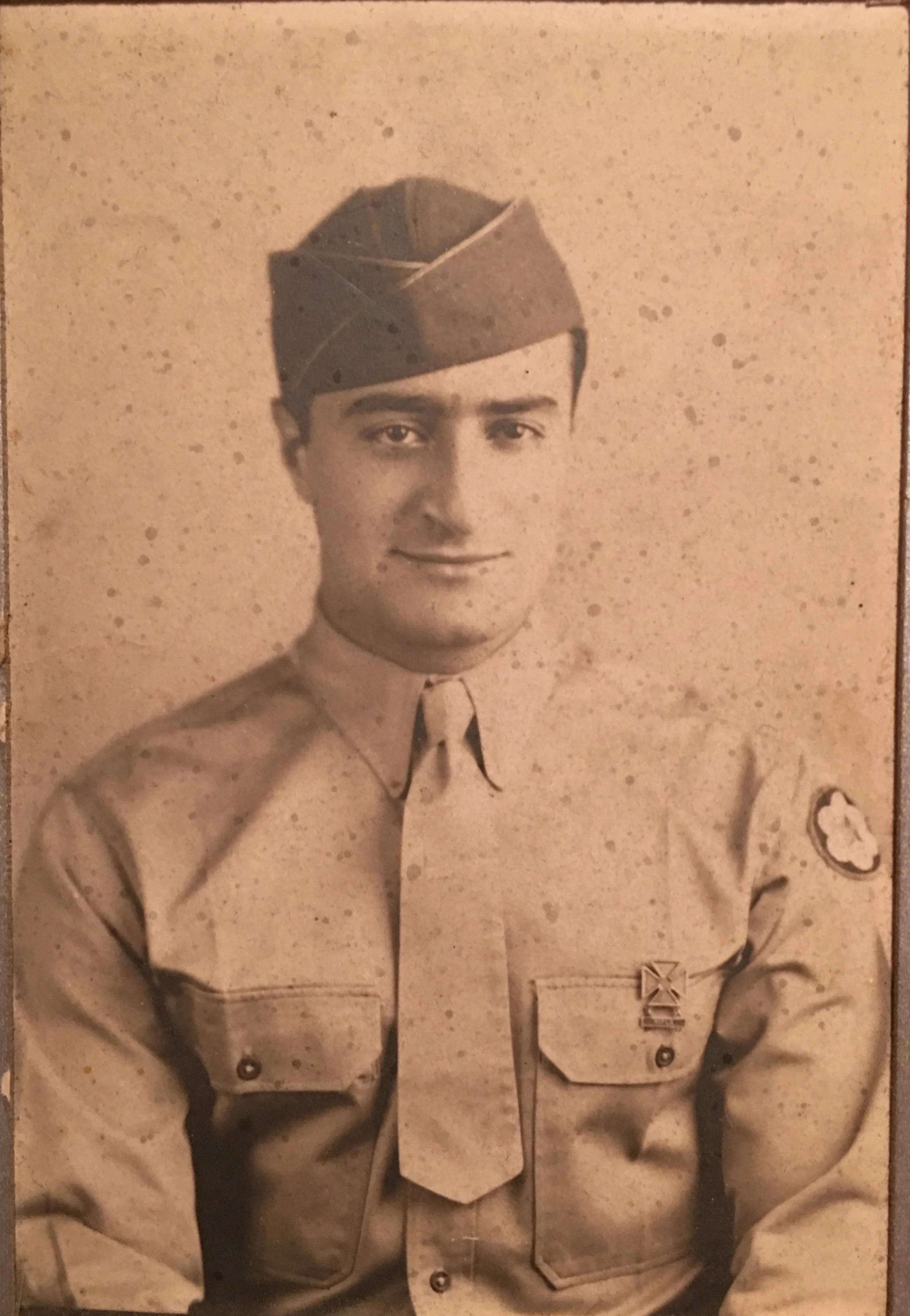
Albert M. Albert · United States Army · World War II
Next Saturday I fly with heroes — and carry everyone who made me
Three years ago I put my name in. I asked to be considered as a volunteer photographer for an Honor Flight out of Cleveland. Nothing came of it, and eventually I moved on. Then a couple weeks ago, out of nowhere, a text arrived. They needed someone. Next Saturday.
Some things find their timing.
I've been a professional photographer since 1988. Over those years I've photographed a lot of veterans — always for free, always with gratitude. It's work that has meant something to me in a way that was hard to fully explain. Until now maybe I didn't need to explain it. To understand why I said yes without hesitation, you need to know where I came from.
You need to know my family.
My father was Master Sergeant Albert M. Albert, United States Army, World War II. He read his Bible in the foxholes of the Pacific. He walked through Hiroshima after the bomb. He came home and never made a big deal of any of it.
He served as head of communications in the Pacific theater. After the bomb dropped on Hiroshima, he was among the American servicemen sent into that city to dismantle radio equipment — in those first days, before anyone fully understood what the radiation meant. He walked through it. He came home.
He had eight siblings. Six of them died from cancer. My father, who walked through Hiroshima, never got it. In the foxholes before all of that, he had his Bible open. He was a man who knew exactly what he believed and why — because he had seen enough to leave no doubt. Occasionally a story from those years would surface, always carrying the same thread running through it: he knew God had saved them from destruction.
He didn't talk much about the war. That was his generation. You did what was asked, you came home, and you got on with living. He raised a family, held his faith, and led quietly. That's what Master Sergeants do.
He's been gone for years now. But next Saturday I'll be standing at the World War II Memorial in Washington, D.C., with a camera in my hands and his memory in my chest.
Then there was my mother. She was the glue. She believed in me completely — not conditionally, not cautiously, but fully and without reservation. I was a mama's boy, and I wear that without apology. She told me I could do anything I wanted with my life. She meant it every single time. When I found her in 2013, gone without warning, it was the hardest thing I have ever carried. Some things you don't get over. You just learn to hold them differently.
My oldest brother, Michael, is fourteen years my senior and has been a rock in my entire life. When the business got tight — and in thirty eight years it gets tight — Michael was there. He backed me. He believed in me. He picked up a camera and worked events beside me when I needed another set of hands. He never made it feel like a favor. That's just who he is.
My sister Christine is in the middle of us — 68 years old, sweet to her core, living with some issues that have made her path harder than it should have been. Michael and I look after her. She doesn't fully grasp what this trip means historically, but she always wants to know about my jobs. Always asks how it went. Always proud of her little brother. Sometimes that uncomplicated love is the most sustaining kind there is.
And then there was Jim.
Jim was thirteen years older than me — a mentor, a guide, a force. He shot Leica his whole life. Voigtlander, M8, M9 — he'd come downtown Canton, retired, Leica in hand, working slowly and deliberately the way rangefinder photographers do. I used to laugh at him. How long everything took. Why not just use an autofocus camera and get on with it?
Jim never argued the point. He just kept shooting.
When he got sick in 2021 — complications from Covid — I made him a promise. When he got out of the hospital, I was going to buy him a Leica 28mm Elmarit. Something he'd always wanted. A gift between brothers who had spent years laughing at each other across camera systems.
He never made it out of the hospital.
I inherited his cameras. The M9 had a sensor issue. The M8 still works — exactly the way Jim left it. And somewhere in the grief of those months I picked up his Leica and something shifted. I bought gear, sold it, bought it back. I couldn't let it go. The first time around I just couldn't find the feel. But now I do.
A store owner downtown told me not long after Jim passed — Jim used to come in and talk about his little brother. How proud he was. How I'd built something real. Jim never said that to my face. That's brothers. You say the important things to strangers instead and hope it gets back.
It got back.
So next Saturday I'll carry a Leica M10R with a 50mm APO — a lens I traded three others to own — along with a 35mm and a 26mm. Small, quiet, manual focus. A camera that asks you to slow down and pay attention. Jim tried to teach me that for years. I just needed to lose him to finally understand it.
The itinerary is full — the Navy Memorial, the WWII Memorial, the Vietnam Wall, the Lincoln Memorial, the Korean Memorial, Arlington Cemetery, the Tomb of the Unknown Soldier, the Iwo Jima statue. Fourteen hours. A group of veterans, most of them in the later chapters of their lives, finally making this trip. I've been asked to document it.
I take that seriously. But I also know there will be a moment at the World War II Memorial — standing where Master Sergeant Albert M. Albert's war is honored in stone — when I'll have to set the camera down for a second and just be a son.
I'll carry my father's faith. My mother's voice telling me I can do anything. Michael's steadiness. Christine's uncomplicated love. And Jim's camera, with Jim's patience, finally making sense in my hands.
Somewhere Jim will be standing next to me, finally getting the last laugh about the Leica.
I'll share images when I'm back. Until then — if you know a veteran, tell them thank you. If you still can.
J. Albert
J. Albert Studios · Canton, Ohio
