
45 Miles an Hour
A small cemetery off Faircrest Street, and 185 years of Canton history that most people drive right past.
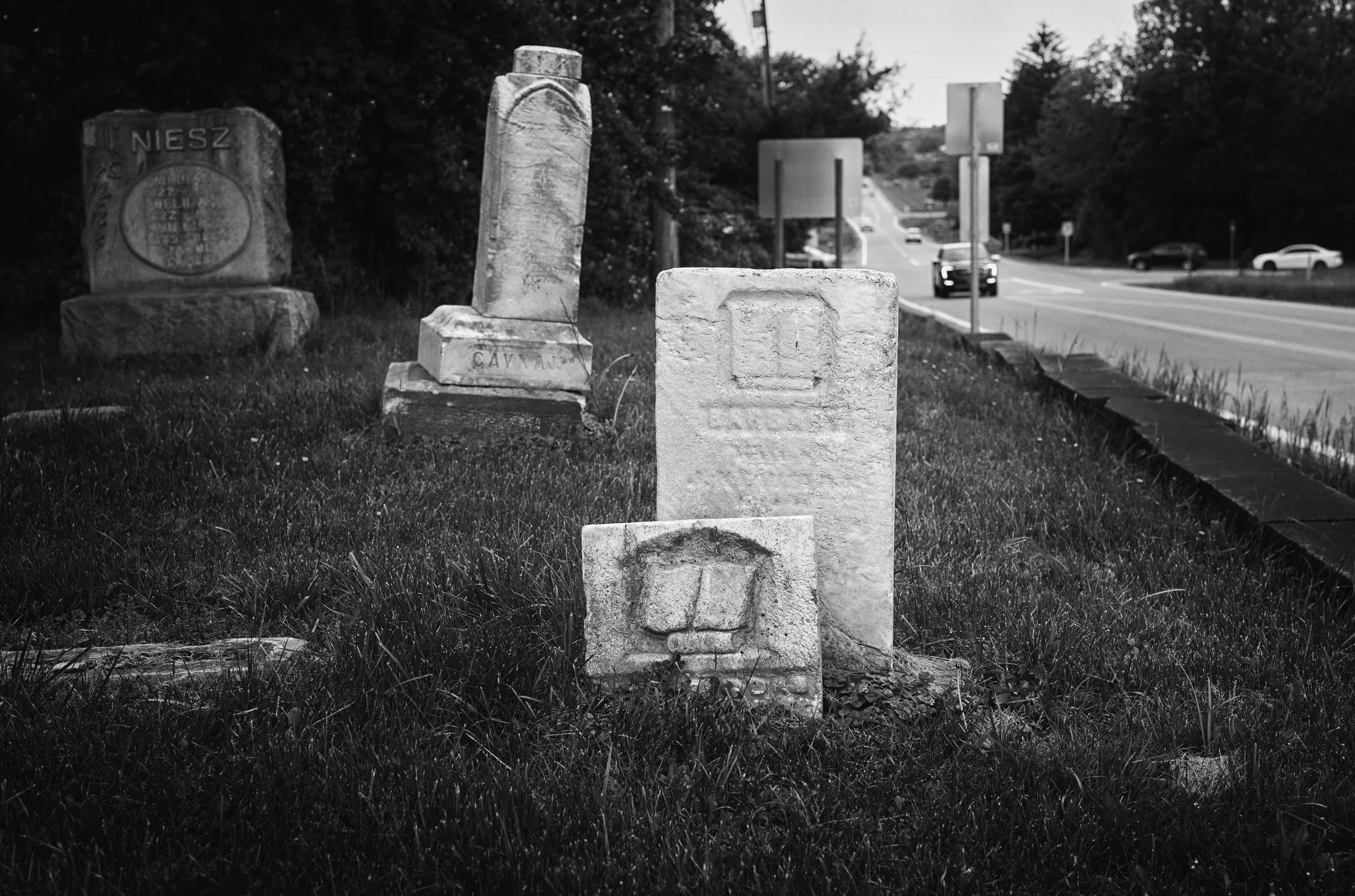
I wasn't planning to stop. I had a house shoot lined up, a client waiting, and a schedule to keep. But something about the little cemetery caught my eye as I came down OH-627 — a few headstones in an open field next to a worn-out brick church — and I pulled over before I'd made a conscious decision to do it.
That happens sometimes. The M10-R has a way of making you honest about what actually deserves a frame.
The cemetery sits right at the edge of the road. Not set back. Not protected behind a fence. Just there, at the shoulder of the state route, where the guardrail and the grass meet. At some point over the decades — as the road was widened, as traffic increased, as the world moved faster — a few of the older stones got pushed closer and closer to the margin. Nobody made a decision to disrespect them. It just happened the way things happen.
The cars on OH-627 don't slow down. They never did. That's the whole picture.
I walked in and started shooting
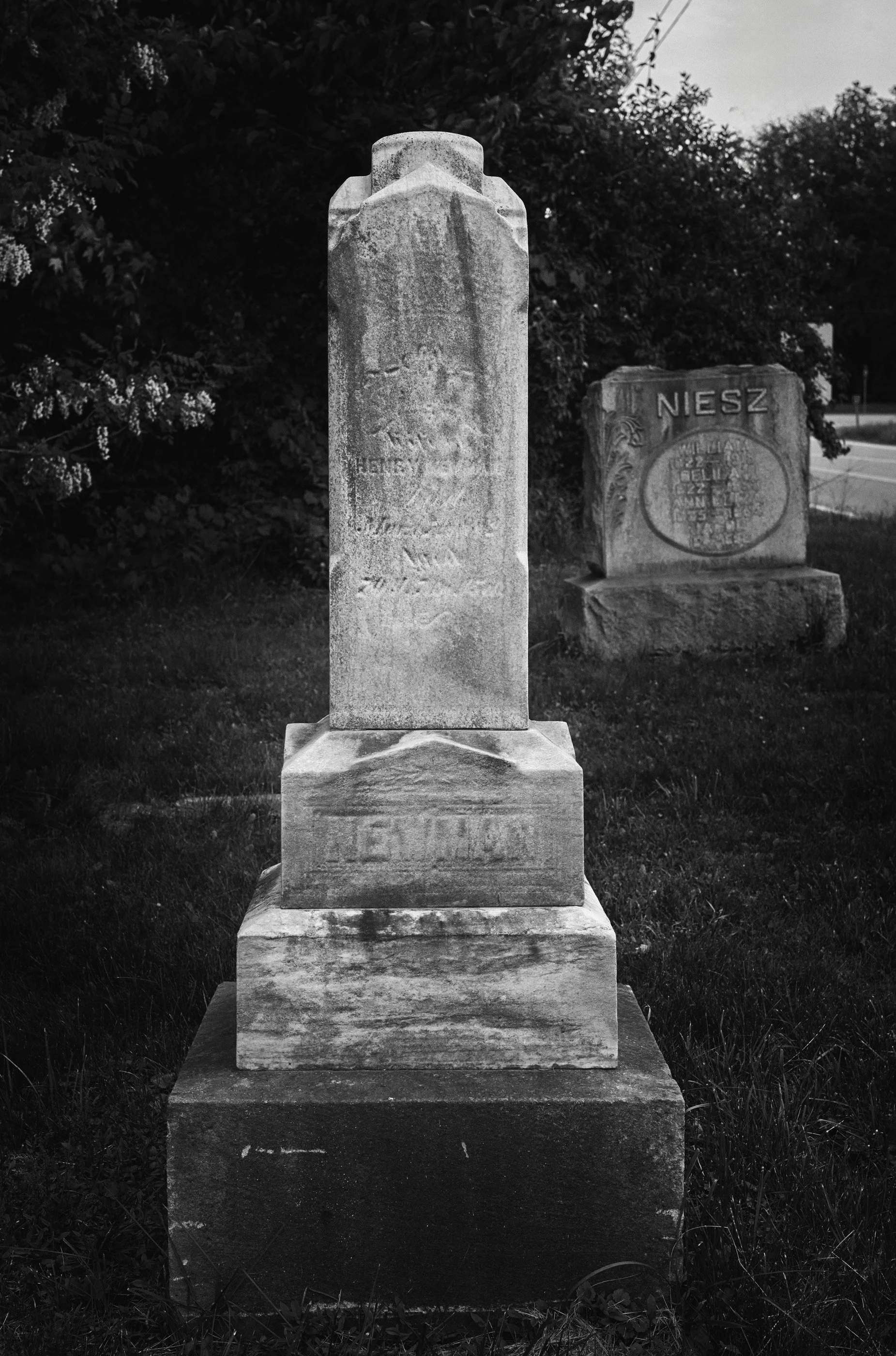
The Newman stone in the foreground, the Niesz family marker behind. The road is just visible through the trees on the right.
The cemetery is small — maybe a dozen visible stones, a large granite obelisk near the road, overgrowth pressing in at the edges. The church next door was red brick, Gothic arch windows, a food pantry sign out front. It had clearly been through several lives — renamed, repurposed, quietly persisting the way small Ohio churches do.
The first stone that stopped me was a family marker. The Niesz family. William. Delilah. Annelizia. And then at the very bottom, almost as an afterthought carved into the sandstone: Two Infant Sons. No names. No dates. Just that. The whole weight of 19th-century mortality compressed into three words.
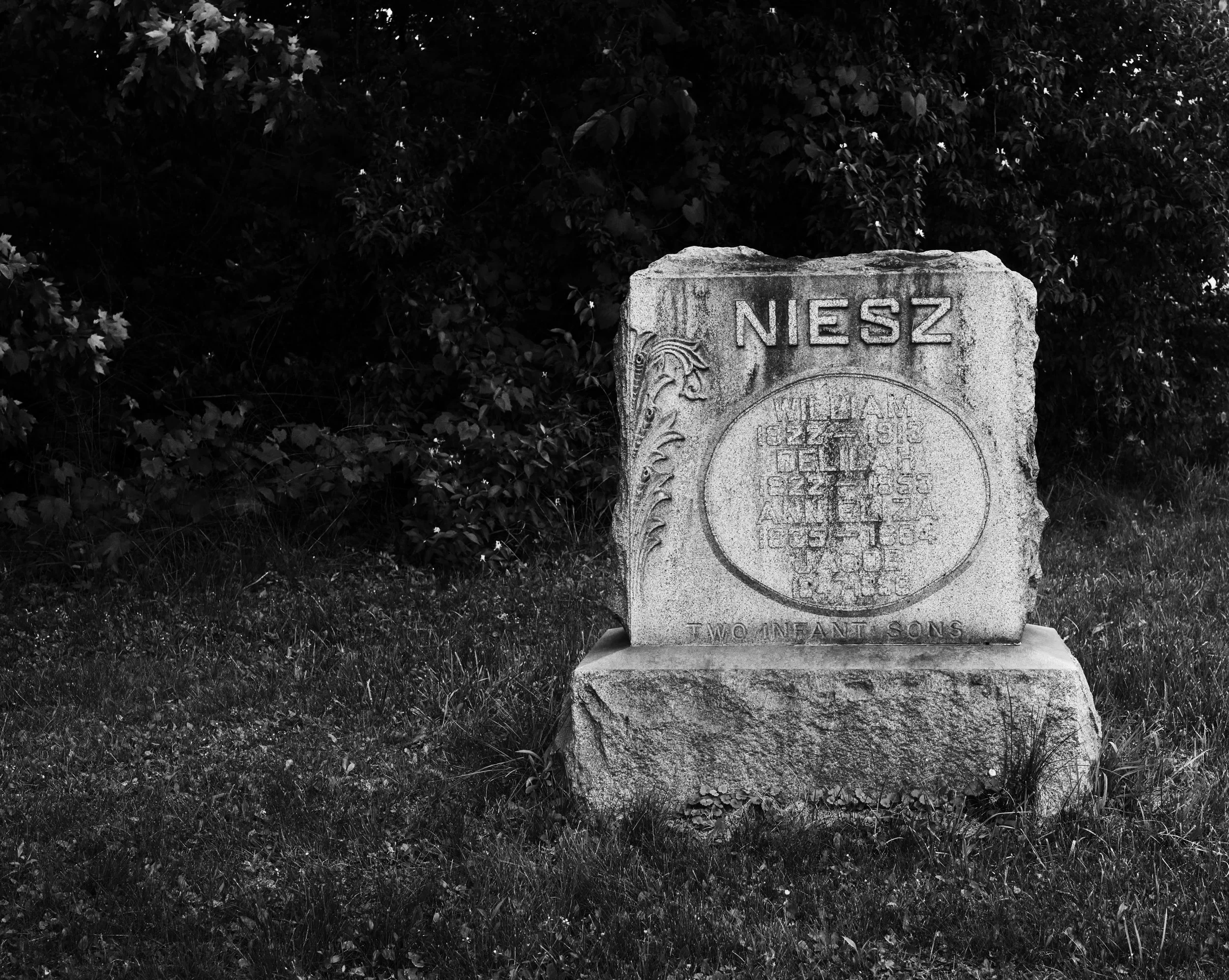
The Niesz family marker —
William, Delilah, Annelizia, and "Two Infant Sons
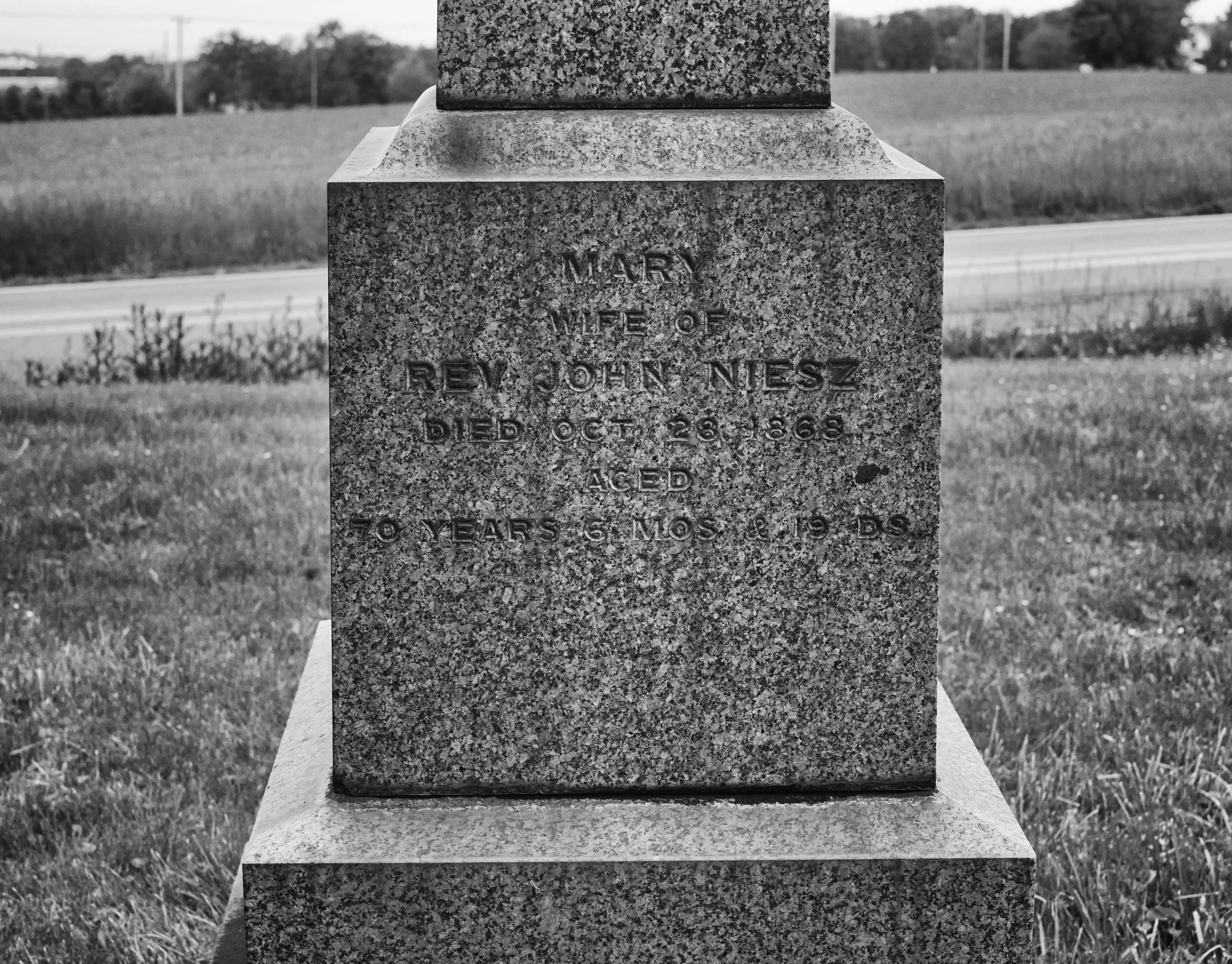
The base of the obelisk
Mary, wife of Rev. John Niesz, died October 23, 1868, aged 70 years, 5 months and 19 days.
The obelisk belonged to the Reverend John Niesz — or rather, to his wife Mary, who died in 1868. I did some digging when I got home. The story of Rev. Niesz is one of the more remarkable things I've come across in Canton Township.
In his younger years he was actively irreligious. He belonged to a group that published a paper in favor of infidelity. Then in 1831, one of his young children died while — according to his obituary — "shouting praises to Christ." That moment broke him open. He became ordained, and in 1841 he built a church on the corner of his own farmland, setting aside adjacent land as a cemetery. The man went from publishing anti-religion pamphlets to building a church with his own hands. This ground was his from the start.
He built the church in 1841. By the 1860s, young men from that same congregation were coming home from the Civil War — to be buried in the ground the reverend had set aside
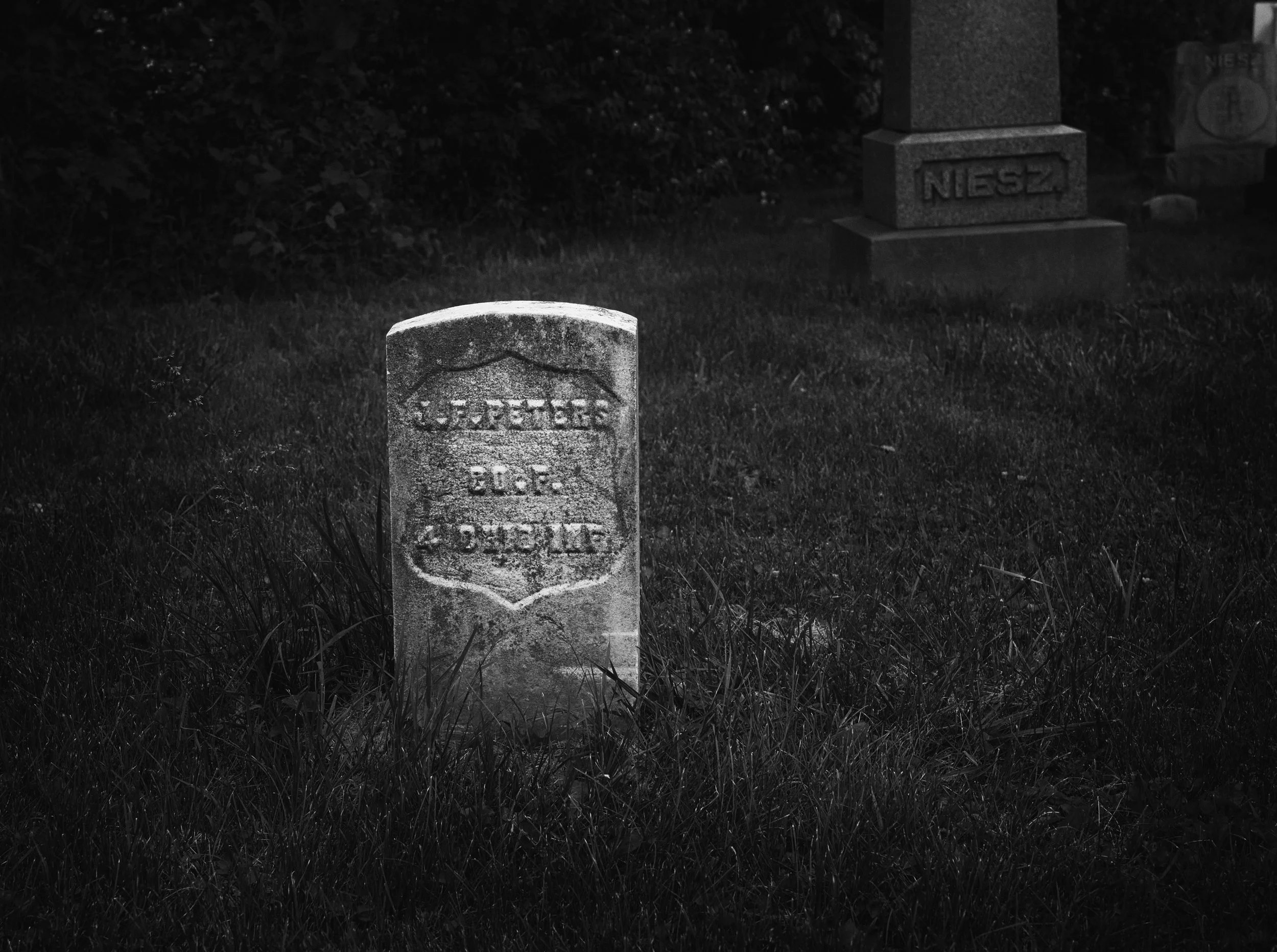
The government-issued marker of J.F. Peters, a Union veteran. The shield shape and plain lettering are unmistakable. The Niesz family stone stands behind him.
That small government-issued stone — the shield shape, the plain lettering — is a Union soldier's marker. J.F. Peters, Company F, likely the 4th Ohio Infantry. He was a member of this congregation, or at least a neighbor, buried here after the war. Rev. Niesz had consecrated this ground two decades before Peters ever left for the front.
I kept walking. And then I found this.
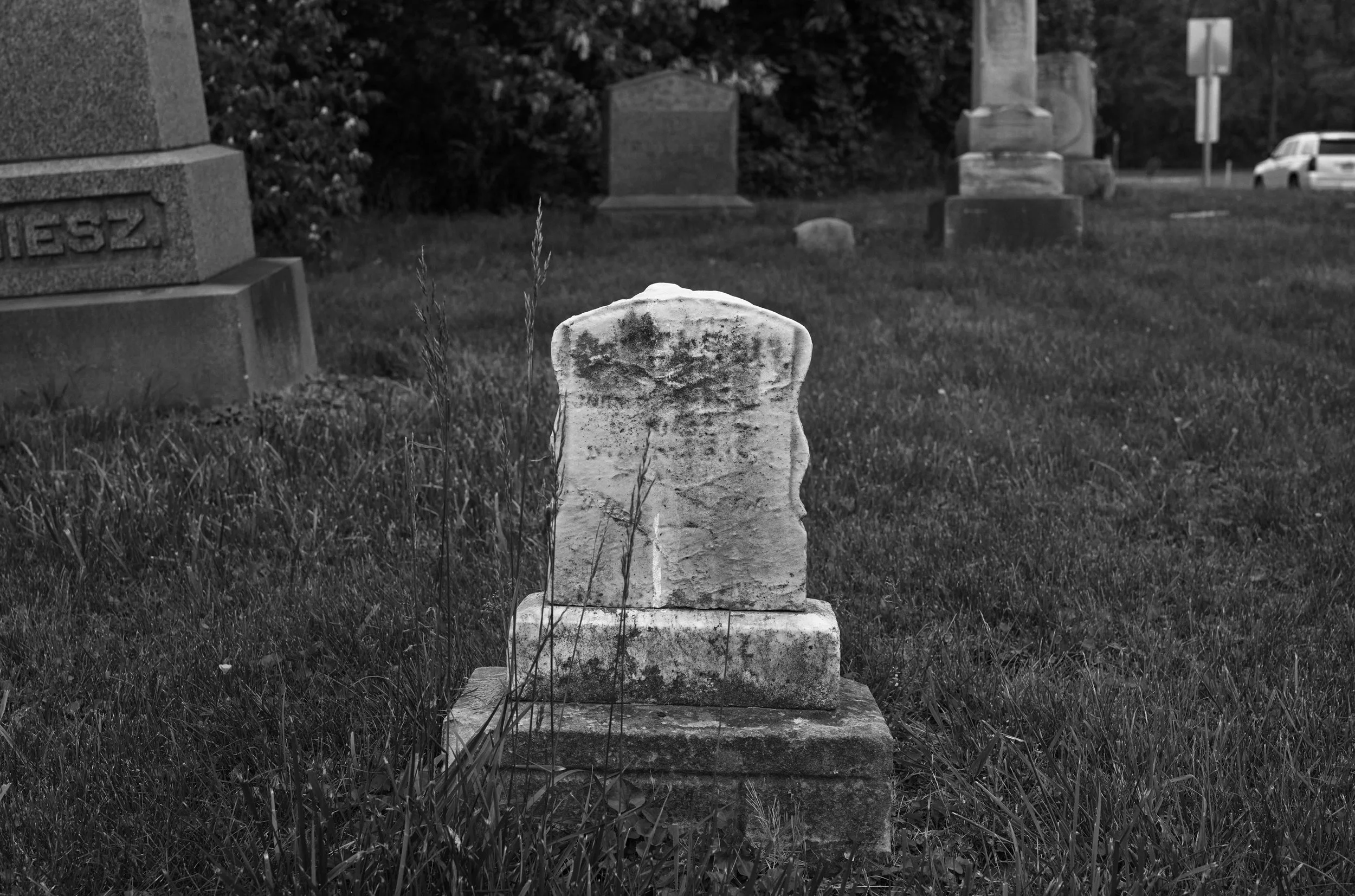
No name. No dates. A single weed growing through the crack. Someone is buried here. We'll never know who.
Somebody is buried here and we will never know who. That's not a mystery. It's just the end of the line for a human being.
The inscription is gone. Not damaged — gone. Whatever name was carved into that stone has been erased by time as completely as if it were never there. A single weed has pushed up through the crack between the stone and its base, filling the silence the way nature always does eventually.
Behind it, the rest of the cemetery stretches out. Other stones still standing. Other names still holding. The Niesz obelisk anchors the left edge. A road sign and a passing car are visible in the upper right. The world, still moving.
I think about this sometimes — the things that exist in plain sight along roads we drive every day. This cemetery has been here since 1841. Reverend Niesz died in 1872. J.F. Peters came home from the war and was buried here. Families brought their infants and their elders and carved their names into stone because that felt like it would last.
For most of them, it did. For this one, it didn't.
I'm glad I pulled over.
